• A Cage Went in Search of a Bird

    1x1 Art Gallery / November 16, 2025 - March 31, 2026

A Cage Went in Search of a Bird

A Cage Went in Search of a Bird: Traces of Belonging, Forms of Freedom


“We are instructed to do the negative; the positive is already within us”

~ Franz Kafka, The Zürau Aphorisms


What must we make of a world that is peopled by objects? How to inhabit a landscape whose terrain is the detritus of

constructed space? With what language can we speak about the incomplete gestures of development and urban-

movements alive with the absence of human control? Kafka’s epiphany of inversion materialises a theme that he dealt with all

his life – the surreal, impossible quest of human existential endeavour. This is a quest fictionalisedthrough his

imaginarium of phantasmagoric animals, human subjects confronted by absurdist distortions, and bureaucratic machines. His

pronouncement “A cage seeking a bird” – written in 1917, and appearing as a singular fragment of text, like the others

in The Zürau Aphorisms – ruptures the relationship between structure and agent. The system forgets its impulse to regulate

and interpellate. It is detached from structuration and no longer acts as a device of imprisonment – the “cage” becomes a

metaphor for the crucible of identity and purpose. But this crucible – this architectural frame – embraces flight, and the desire

for freedom, restless in its quest for release.

The artworks serialised into a narrative of erasure, absence, and re-presence in A Cage Went in Search of a Bird frame the

viewer’s sensing body within such a schizoid universe. In their spatial expanse that flares as a paradox, architecture is

broken into its elemental gestures: the wall that remembers division, the grid that disciplines vision, the threshold that marks

entry and exclusion. These traces of things and objects acquire life in the absence of breath – they are minions of gaze and

anatomy repurposing space as deconstructions of structure, dislocation, and migration. These more-than-human beings surge

into meaning in the absence of the empirical familiarity of anthropocentric life reworking humanity itself within a horizontal

inventory of objects. Seen in concert, the artworks ask a potent question: Drenched as we are in the emotional core of human

sensation, cognition, and apprehension – how can we reach a space of awareness that precedes the body? Can we conceive of a

world where design anticipates desire?

Sculpted forms slip into being by gesturing towards an antonym of space – a kind of reverseplacemaking. We are struck by this

“negative” manifestation of space: how it shapes belonging, how it remembers occupation, how it imagines the dream of

community, and association, and how, even emptied, it continues to wait. But the objects drawn, painted, and sculpted into

three dimensional forms oscillate between awkward performance, silent comradeship, and intermittent spectacle. In this regard

– they do not mirror or reflect humanity, but convey a vision of its rearticulation as a flat ontology.

Can we think of inhabited and abandoned space not through the lens of human control over nature, and not in its reversed form

either – where “machines” take over humanity -but alongside more-than-human presence? In such a conception, aerial views of

cities, maps and territories, high-rises, homes, buildings, natural terrains, and topographies – even the meta-narratives of giant

orbs and “pale blue dots” – come into being within a “political ecology” of human, natural, and material life. The works acquire

this quality not by proposing the objects as superior, spectacular, or dominant, but by tracing the artists’ sensitivity to form,

shape, and material manifestations or curves, edges, and shadows. Each artist navigates this geography probing how the

language of built form can be recast outside the realms of our inherited enclosures, and how it can subvert our search for

openings and exits.

This “reverse placemaking” or a “negative” manifestation of lived space is articulated as a question with prophetic

sensibility, in Nikolaus Geyrhalter’s experimental 2016 cinematic masterpiece Homo Sapiens: “What will remain of our lives after

we’re gone?” The documentary film, much like the current exhibition, is made up of derelict human-made landscapes that are

devoid of humanity, increasingly overgrown with vegetation, and decaying material. The 94-minute long montage of abandoned

cities, ruins, public and intimate spaces, both large and small, narrativise the body politic and the anatomy of the social. These

images propose a vision of the place of humans – what it means to be human in a decaying teleology. The affective force of

these images is unnerving in its aesthetics of rupture. The quest for truth, identity and place in A Cage Went in Search of a

Bird resonates with this impulse – even gesturing towards post-human futures in the present.Architecture and Cartography as an Exercise in World-Making

Framed within this curation of world-making that forms a fragmented continuity between body, place, and time, the works use

perspective and form as freeing devices – locating their belongingness through material and style.

In Vibha Galhotra’s (2024-25) mixed media works, Melting and Fragile (2024-25), everyday materials including ghungroos,

beeswax and fabric, chart a precarious path of a planet in distress. The works exude a quiet energy of decay, embodying the

slow collapse of systems and communities, where only echoes remain.

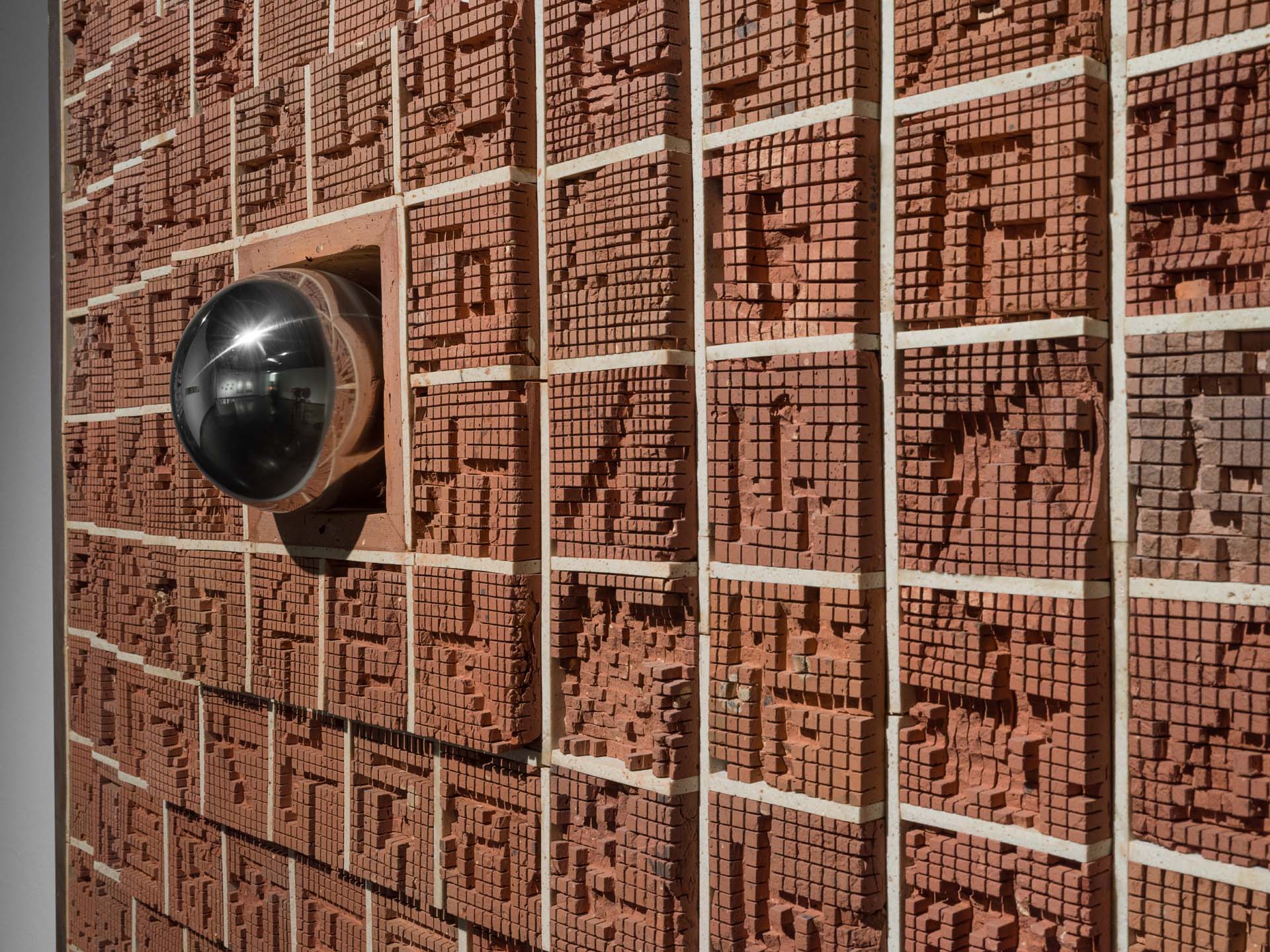
The distorted form of the map dialogues with a terracotta topography in M Pravat’sTerraform (2024) while the globe resurfaces

as a comment on change, movement, and fragile constructions in the fired bricked-and-mortar aesthetic of The Malleability of

All Things Solid (2023).

The play of erratic lines and overarching axes recompose the social implications of migratory movements and urban

transformation in vectors of colour and speed. Colour and “kitsch” abound in Vivek Vilasini’s Housing Dreams – an archival print

of “walls” of residence, that transpose identity and social dynamics through brash, outspoken shades and patterns. These

vibrant images are metonymic placeholders for dreams and aspirations framed by surveillance, cultural perception, and power.

Martand Khosla’s explosive etchings and sculptural forms shock through their visceral syntax of excess.

Documenting urban overwhelm with projectile-like fervour, the works draw out that now-familiar characterisation of global

cities that are “splitting at the seams”.

Chittrovanu Mazumdar’s mobile caravan in Dream, Prometheus…. metamorphises Prometheus into a human-made

construct fleeing with “contained” light, stolen from the gods, only to be given to a civilization that has exceeded itself. The work

is a literal manifestation of the Kafkaesque image that is the title of the show.

Dilip Chobisa’s constructed neighbourhoods are strangely dystopic – using a chiaroscuro of shadow and light to disentangle the

familiarity of inhabited space with foreboding and the mystery of abandonment. The series entitled “Who owns it?” (2024)

indicates the absent presence of authorship, but also, control. These works make us feel like trespassers – a sensation that

grows out in concentric ripples of apprehension.

Praveen’s tactile paintings juxtapose precise architectural renderings with ethereal, fragmented forms, using intermittent gold

and cement. These works explore transformations between the imaginary and the real, nostalgia and aspiration, desire and

memory.

Pooja Iranna’s staple-pin compositions reconstruct and deconstruct the urban sprawl as built forms that emulate the

deliberate aggregation of unreal estate. Symphony 1 (2025) redraws her characteristic material aesthetic in an interesting

direction – a haunting circle of fifteen arcs reminiscent of the monumental ritualism and druidic belief of ancient structures such

as Stonehenge, repurposed into a magical possible futuristic architecture.

Parul Sharma’s fragile paper cut-outs in Mind map (2021) queue up as a punctuation mark or a character, of sub-urban

constellations – simple geometric shapes that convey journeys within “lived spaces” and moments caught in transit in the

everyday life of the city.

Gigi Scaria’s brass sculpture Sprout (2024) rises up as a fist carrying a torch, enclosed within the synthetic foliage of

constructions and erections in modern cities. The central image reminds the viewer of the powerful symbolism of

the “crozier” or the “koru” – an unfurled fern, a fungal shroud, or a torch with a shrinking flame.

Nida Bangash’s Bol (Speak) (2025) – a collection of artbooks housed in paper-boxes designed with bright staccato colours, and

gilded with metal leaf, embody the complex tense relationship of “freedom” within the most familiar complex of

belonging and sociality- the home. Using Faiz’s iconinc poem “Bol” the artbook unfurls in its accordion frame, soaring like a bird,

but grounded in the home. Traversing through the dimensions of time, body, tongue, life and death – the book invokes the

passionate fervour and resistance of the verse that begins with “Bol, ke labh aazaad hain tere Bol, zubaan ab takteri hain”

(Speak, your lips are free, Speak,your tongue is still your own).

And finally, in Pallavi Arora’s video work Blueprint (2021-2022) windows open like geometric wings, staircases and landings start

to walk in Escheresque fashion, and facades unfold as drawers. Again, in the absence of the human inhabitant a built form –

a building – moves, acquiring agency and a kind of life.

In the last analysis, then, a cage goes out in search of a bird…in search of a home, perhaps, in search of freedom.

~ Aranya Pad?l